
Yacht Insurance in the South Pacific and Asia: What Owners of Yachts Need to Know
Yacht insurance becomes significantly more complex once a vessel leaves coastal cruising grounds and enters the South Pacific or Asian operating environment. Owners moving yachts through regions such as Auckland, Fiji, Nouméa, Tahiti, or onward to Singapore quickly discover that many standard yacht insurance policies are not structured for offshore passages, remote regions, or professional yacht delivery.
For yachts over 45 ft — particularly modern catamarans and bluewater monohulls — insurance decisions directly affect routing options, crew requirements, seasonal timing, and whether a delivery can proceed at all.
Insurance underwriting in this region is vessel-specific and risk-driven.
Larger yachts attract closer scrutiny due to:
Higher insured values
Greater offshore exposure
Complex systems and structural loading
Catamarans (Lagoon, Leopard, Fountaine Pajot, HH Catamarans) are often assessed differently to monohulls (Beneteau, Jeanneau, Swan, Hallberg-Rassy) due to:
Beam and marina access constraints
Structural behaviour offshore
Bridgedeck clearance and sea state tolerance
Insurers regularly require recent condition surveys, rig inspections, and documented maintenance before extending navigational limits beyond coastal cruising.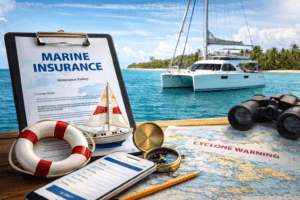
For South Pacific and Asia passages, insurers commonly assess:
Propulsion and steering redundancy
Offshore communication systems
Storm preparation and safety equipment
A yacht may be structurally sound but still be declined coverage if preparation and documentation are not aligned with offshore risk.
Most yacht insurance problems in the South Pacific and Asia arise from misunderstood navigational limits.
Policies that appear “worldwide” often include:
Seasonal cyclone exclusions
Distance-from-shore limits
Mandatory safe ports or routing conditions
For example, insurers may:
Approve New Zealand to Fiji only outside cyclone season
Require defined stopovers between Fiji and Tahiti
Exclude parts of Indonesia or the Philippines without endorsement
Departing outside approved limits — even unintentionally — can invalidate cover entirely.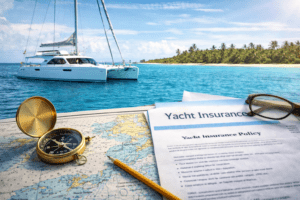
This is particularly relevant for deliveries such as:
Opua → Fiji
Auckland → Nouméa
South Pacific repositioning toward Southeast Asia
Insurance approval in this region is seasonal and route-specific.
Insurers assess:
Cyclone exposure in the South Pacific
Monsoon patterns in Southeast Asia
Length and exposure of offshore legs
While insurers understand weather uncertainty, they expect defensible routing and conservative timing. Marginal seasonal decisions often result in:
Increased deductibles
Restricted cover
Refusal to insure the passage
This is one reason insurers frequently look favourably on professionally managed yacht deliveries.
For offshore approval, insurers may require:
A commercially endorsed skipper
Demonstrable ocean passage experience
Formal watch systems and fatigue management
Owner-only crews often struggle to meet underwriting standards for long offshore passages, particularly on newly acquired yachts.
Insurance policies typically differentiate between:
Private owner operation
Professional yacht delivery
For longer, higher-risk routes, insurers often prefer or require professional delivery crews due to lower claims exposure and better risk control.
Claims in the South Pacific and Asia are:
Logistically complex
Slower to resolve
More expensive than owners expect
Limited repair facilities, delayed surveyors, and parts shortages make agreed value policies far more suitable for offshore yachts than depreciated value cover.
Under-insurance is usually only discovered after an incident — when recovery costs escalate rapidly.
Yacht Delivery Solutions works with owners, brokers, and insurers to ensure yacht movements in the South Pacific and Asia are insurable, compliant, and operationally sound.
This includes:
Reviewing insurance navigational limits before departure
Aligning routing and timing with policy conditions
Providing experienced delivery crew acceptable to insurers
Reducing seasonal and operational risk exposure
For many offshore moves, professional delivery is not just a convenience — it is a practical insurance requirement.
Yacht insurance in the South Pacific and Asia is a risk management exercise, not a formality.
For larger yachts, the wrong insurance structure can:
Restrict cruising plans
Invalidate claims
Force costly delays or rerouting
Owners planning offshore movements should integrate insurance planning, vessel preparation, and delivery strategy into a single decision process.
Yacht Delivery Solutions provides practical support across this entire process, helping owners move high-value yachts safely, professionally, and within insurance requirements across New Zealand, Australia, the South Pacific, and Asia.